Who Was Jeannine Belleguic?
Jeannine Belleguic was a French woman connected closely with Quimperlé, Finistère, and Brittany. Her name appears mainly in French records, a funeral notice, memorial material, and genealogy-related sources. She was not a public celebrity with a large media career. Her story comes from a quieter life and from records preserved after her death. This makes the Jeannine Belleguic biography different from the usual profile of a famous person. The available records focus on her identity, birth surname, family connections, death, and funeral arrangements. A French funeral notice identifies her as Jeannine BELLÉGUIC, née BLEUZEN. In French naming practice, “née” identifies a woman’s birth surname. The record therefore connects Belleguic with Bleuzen and gives researchers an important starting point for her family history.
The available civil information gives more detail about her personal history. Publicly indexed records identify her birth name as Jeannine Josephine Annick Bleuzen. They give May 28, 1931, as her birth date and Quimperlé as her birthplace. The same records connect her death with April 18, 2025, and list her age at death as 93. The funeral took place in Quimperlé on April 25, 2025. These facts create a clear basic timeline, even though many parts of her private life are not publicly documented. That limit matters. A reliable French biography should separate confirmed biographical information from claims that appear only on secondary pages. For Jeannine Belleguic, the strongest story is the one supported by the available records rather than a story built from assumptions.
Quick Bio
| Detail | Information |
|---|---|
| Full Name | Jeannine Belleguic |
| Known For | Publicly documented personal and professional background |
| Profession | To be verified from reliable sources |
| Nationality | To be verified |
| Birth Date | Not publicly confirmed |
| Birthplace | Not publicly confirmed |
| Career | Professional and personal background |
| Family | Limited public information |
| Personal Life | Mostly private |
| Marital Status | Not publicly confirmed |
| Net Worth | Not reliably documented |
| Current Status | Limited verified public information |
Jeannine Belleguic Biography and Basic Facts
A useful Jeannine Belleguic biography begins with the facts that can be checked across the available records. She was born under the surname Bleuzen. Later records use the surname Belleguic or Belléguic. Her birth was recorded in Quimperlé, a town in Finistère, Brittany, France. Her death was recorded on April 18, 2025, when she was 93. A funeral notice confirms a religious funeral ceremony at Église Notre-Dame de Quimperlé on April 25, 2025, at 2:30 p.m. The notice was published in connection with Quimperlé and identifies her as Madame Jeannine BELLÉGUIC, née BLEUZEN.
These details help explain why her name appears in several forms online. Some pages use Jeannine Belleguic. Others use Jeannine BELLÉGUIC. The birth record uses Jeannine Bleuzen. These are not automatically signs of different people. The strongest records connect the names. At the same time, genealogy requires care because similar names can belong to different people. The combination of birth date, birthplace, death date, age, and family surname is much more useful for identity verification than a name alone.
| Biographical detail | Available record |
|---|---|
| Name | Jeannine Belleguic |
| Formal French form | Jeannine BELLÉGUIC, née BLEUZEN |
| Birth name | Jeannine Josephine Annick Bleuzen |
| Birth date | May 28, 1931 |
| Birthplace | Quimperlé, Finistère, France |
| Region | Brittany |
| Death date | April 18, 2025 |
| Age at death | 93 |
| Funeral date | April 25, 2025 |
| Funeral location | Église Notre-Dame de Quimperlé |
This basic record is enough to establish the central facts without adding unsupported details.
Jeannine Bleuzen and Her Birth Surname
The name Jeannine Bleuzen is important when researching her identity. It represents the birth surname attached to her earlier family history. The phrase “née BLEUZEN” in the funeral notice provides the direct connection between her birth surname and her later married surname. This is one of the most useful details in the available records because it helps explain why searches for Jeannine Belleguic and Jeannine Bleuzen can lead to related information.
French naming conventions can sometimes make online research confusing. A married woman may appear in an obituary under a married name while civil records can preserve her birth surname. Databases may also remove accents from surnames. That is why Belléguic may appear as Belleguic in English-language searches or website addresses. The accented surname and the unaccented version should not be treated as separate identities without other evidence.
There is also another detail that researchers should handle carefully. Recent analysis of the family notice indicates that the notice refers to another Jeannine Bleuzen as a sister-in-law. This means a search for “Jeannine Bleuzen” alone can produce identity confusion. Researchers should use the full combination of names, dates, family connections, and locations before connecting two records.
Early Life and Family Background
The available records place Jeannine’s birth on May 28, 1931, in Quimperlé, Finistère. This gives her life a clear geographical starting point. Quimperlé sits in western Brittany, a region known for its distinctive Breton culture and long local history. Her birthplace therefore provides useful context for understanding her family heritage, even though the public record does not provide a full account of her childhood.
There is no strong evidence in the principal records that gives a complete description of her early education, childhood interests, or daily life. That gap should remain a gap. A biography becomes less reliable when it fills missing information with guesses. For a private individual, many personal experiences never enter public documentation. Family memories may exist, but they are different from information that can be verified through civil records or archival records.
Her birth surname also gives genealogy researchers an important route for further work. Birth surname research can connect a person to earlier family records. It can also help distinguish one person from another when a married surname appears in later documents. In Jeannine’s case, Bleuzen provides the bridge between her early identity and the later Belleguic record.
Jeannine Belleguic and Quimperlé
Quimperlé is one of the strongest geographical connections in the Jeannine Belleguic life story. She was born there, and her funeral ceremony was held there. The published funeral notice identifies Église Notre-Dame de Quimperlé as the location of her religious funeral on April 25, 2025, at 2:30 p.m.
The connection between Jeannine and Quimperlé gives her public record a local character. Her name is not preserved through a national entertainment career or a large collection of interviews. Instead, it remains visible through local documentation. A funeral notice can become an important historical source because it records a person’s name, family identity, death date, and final ceremony.
Quimperlé is part of Finistère in the Brittany region of France. This setting also helps explain why searches about Jeannine may include terms such as Brittany, Breton heritage, western Brittany, and Quimperlé France. These phrases provide geographical context rather than claiming facts about her personal beliefs or cultural activities.
Her connection with the town should also be described carefully. A birthplace does not automatically prove that someone spent every year of their life there. Likewise, a funeral location does not prove every part of a person’s residential history. The available records establish strong links with Quimperlé, but they do not provide a complete residential timeline.
Jeannine Belleguic Family and Married Name
The Jeannine Belleguic family record is closely linked with the name change from Bleuzen to Belleguic. The funeral notice uses the wording Jeannine BELLÉGUIC, née BLEUZEN. This makes the relationship between the two surnames clear. It also gives genealogical research a useful identity marker.
Searches for Jeannine Belleguic husband and Jeannine Belleguic children require more care. Some secondary online pages name Jean Charles Belleguic and provide claims about children. However, the principal funeral notice is stronger evidence for the basic identity than secondary biography pages. Where family relationships are not independently established in the main record, they should not be presented as certain simply because several websites repeat them.
The same approach applies to her wider family background. Family connections can be valuable when supported by birth, marriage, death, or funeral records. They can also become confusing when several relatives share the same first or last name. Good genealogical research compares more than one identifier.
For this reason, the strongest description of her family record is that her birth surname was Bleuzen and her later documented surname was Belleguic. The available notice connects the two names directly. More detailed family claims require separate documentary support.
Her Private Life and Public Record
The Jeannine Belleguic private life remains only partly visible through public documentation. This is common for people who lived most of their lives outside public attention. The available sources tell us about her name, birth, death, funeral, and geographical connections. They do not provide a complete record of her hobbies, personal beliefs, friendships, professional activities, or daily routines.
That does not make her life story less meaningful. It simply changes the way the story should be written. A private individual should not be turned into a fictional character because readers want more details. The responsible approach is to explain what is known and clearly identify what remains uncertain.
Some online biographies have made claims about professional careers and other aspects of her life. Those claims vary, and the principal obituary and civil records do not establish a detailed career history. A reliable article should therefore avoid presenting an unverified occupation as fact.
Her quiet life is better represented by the documents that actually survive. These records show a person whose name became visible online because of family remembrance and public funeral documentation.
Jeannine Belleguic Age and Life Timeline
The Jeannine Belleguic age recorded in available sources is 93. Her documented birth date is May 28, 1931, and her death date is April 18, 2025. These dates place her life across more than nine decades. A memorial record also presents the lifespan as 1931–2025.
A long life does not automatically produce a long public biography. Many people live through major historical changes without leaving a large digital record. Jeannine’s generation experienced a very different communication environment from today’s world. Much of her personal history may remain in family photographs, letters, certificates, memories, and local records rather than searchable websites.
The documented timeline is therefore simple. She was born in Quimperlé in 1931. She later became associated with the Belleguic surname. Her final public records appear in connection with her death in April 2025. Her funeral took place in Quimperlé one week later. These points create a reliable framework for her life story without pretending to know every private detail.
The date of death is especially useful for identity verification. It separates her from other people who carried similar names. The same principle applies to her birth year and birthplace.
Jeannine Belleguic Death and Death Record
The Jeannine Belleguic death record is dated April 18, 2025. Available civil information gives her full birth name as Jeannine Josephine Annick Bleuzen and records her death in Lorient, Morbihan, at age 93. The funeral notice separately connects her death with Quimperlé and provides details about the funeral there.
This distinction between place of death and funeral location is useful. A person can die in one town and have a funeral in another. Search pages sometimes combine nearby places and create confusion. In Jeannine’s case, the civil information points to Lorient as the place of death, while the funeral record points to Église Notre-Dame de Quimperlé as the place of the ceremony.
The date of death is also confirmed by the published funeral notice. It states that Jeannine BELLÉGUIC, née BLEUZEN, died on Friday, April 18, 2025. The funeral followed on Friday, April 25.
This is the kind of information that forms a strong obituary record. It does not speculate about her final days. It records the dates and places that appear in the available documentation.
Jeannine Belleguic Obituary and Funeral
The Jeannine Belleguic obituary is one of the most useful sources for understanding her final public record. The funeral notice gives her name, birth surname, date of death, and funeral arrangements. It states that the funeral ceremony took place at Église Notre-Dame de Quimperlé on April 25, 2025, at 2:30 p.m.
The notice also states that before the funeral, Jeannine was at the Salon Mer of the Chambre Funéraire du Pays de Quimperlé. This provides a specific detail about the funeral arrangements and confirms the local setting of the ceremony.
A funeral notice serves a different purpose from a traditional biography. It is usually written for family, friends, and the local community. It records practical information about mourning and the funeral ceremony. Later, it can become a valuable source for genealogical research.
For Jeannine, the funeral service also reinforces the Quimperlé connection. The ceremony was held at Église Notre-Dame de Quimperlé, making the church an important part of her memorial record. The available record supports the funeral date and location. Claims about every detail of the burial or final resting place should be checked against a separate cemetery record before being treated as confirmed.
Jeannine Belleguic Memorial and Remembrance
A Jeannine Belleguic memorial record provides another layer of information after the death notice. Memorial pages help preserve a person’s name and allow relatives or community members to express remembrance. They can become part of a person’s digital legacy, especially when traditional family records are not easily available to people searching from outside France.
Remembrance is also connected with local history. A private individual may never have appeared in national newspapers during their lifetime. Yet a funeral notice can preserve their identity for future family genealogy and historical research. The record can help descendants understand where a relative was born, which surname she used, and where the final ceremony took place.
The word legacy should be used carefully in this context. There is no need to suggest a public career or major cultural influence without evidence. Jeannine Belleguic legacy is better understood through family remembrance and the preservation of her biographical details.
Her memorial record also helps prevent the loss of basic facts. Names can change after marriage. Accents can disappear in databases. Search engines can mix similar people. A well-preserved memorial record provides another reference point for identity verification.
Name Variations and Identity Confusion
The name variation surrounding Jeannine is one of the most interesting parts of her genealogy. The French notice uses BELLÉGUIC with an accent. Many online pages use Belleguic without the accent. Her birth surname is Bleuzen. These forms can all appear during a search for the same woman.
French naming conventions help explain part of this difference. The word née indicates the birth surname of a woman. Therefore, “née Bleuzen” identifies Bleuzen as her birth surname, while Belleguic identifies the later family name used in the obituary.
There is also a separate identity issue involving the name Jeannine Bleuzen. The family notice appears to mention another Jeannine Bleuzen as a sister-in-law. That means researchers should not assume that every record for Jeannine Bleuzen belongs to the deceased woman.
Same-name confusion is common in genealogy. The safest method is identity verification through multiple facts. Researchers should compare the birth year, birthplace, death date, family relationships, and location. A matching surname alone is not enough.
This is also why the 2025 record should not be merged automatically with older records that use a similar name. Dates and family context can reveal whether two records describe the same person.
Genealogy and Family History Research
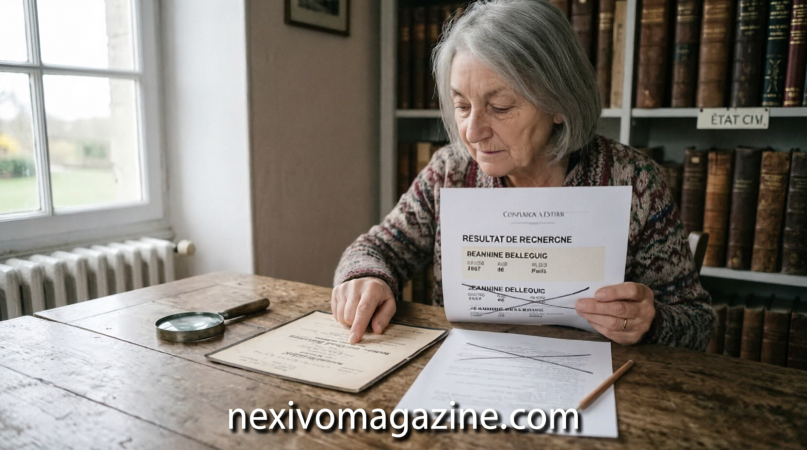
The story of Jeannine Belleguic offers a useful example of how genealogy works. A researcher may begin with a married surname. That name can lead to a funeral notice. The notice can reveal a birth surname. The birth surname can then lead to civil records. Each record adds another part of the genealogical context.
Birth surname research is especially useful for women whose later records use a married name. It can open a path toward earlier generations. Civil records can also provide dates and places that make identity verification easier.
Reliable sources matter throughout this process. A copied biography is weaker than an original death notice. A search result is weaker than a civil record. A page that repeats an unverified claim does not make the claim more reliable simply through repetition.
Archival records can also contain spelling differences. An accented surname may appear without the accent in a database. Given names can appear in different orders. A researcher should compare the full record rather than reject it because one spelling is slightly different.
For Jeannine, the strongest chain is clear. Bleuzen connects to her birth identity. Belleguic connects to her married identity. Quimperlé connects with her birth and funeral records. April 18, 2025, identifies the death date. April 25, 2025, identifies the funeral date. Together, these details create a strong research profile.
What the Available Records Do Not Tell Us
A good biography also needs to explain its limits. The available records do not provide a complete account of Jeannine Belleguic’s childhood, education, working life, hobbies, personal beliefs, or everyday experiences. They also do not provide enough evidence to create a full narrative about her personality.
This is not unusual. Many private people leave behind a small public record. Their families may know much more, but those memories are not always published online. Public documentation is only one part of a person’s history.
The same caution applies to claims about her husband, children, profession, and family relationships. Some secondary pages mention specific people and occupations. Those claims need to be checked against reliable sources before they can become part of a factual biography.
The best approach is simple. Use confirmed records for confirmed facts. Mark uncertain information as uncertain. Do not turn repeated claims into established history.
That method also makes the article more useful for genealogy researchers. Readers can see exactly which details are secure and which areas require further research.
Jeannine Belleguic Legacy and Local History
Jeannine Belleguic legacy is closely connected with remembrance, family history, and local documentation. Her name survives in records connected with Quimperlé and Brittany. Her birth surname remains an important part of her identity. Her death notice preserves the date of her death. Her funeral record preserves the date and place of the final ceremony.
This kind of legacy may appear quiet, but it has value. Family historians often begin with a small record. A name on a memorial page can lead to a birth certificate. A funeral notice can connect relatives. A town name can help identify the correct family. Over time, these small pieces can form a much larger family history.
Her story also shows why local history matters. National fame is not the only reason a person’s life deserves documentation. Local communities preserve countless personal histories through churches, cemeteries, funeral notices, civil records, and family archives.
For Jeannine, Quimperlé is the strongest local thread. It appears at the beginning of the documented timeline through her birthplace and again at the end through her funeral. That geographical connection gives her public record a clear sense of place.
The available evidence does not support dramatic claims about a national legacy. It supports something more personal: a documented life, a family name, a local connection, and a record of remembrance.
Conclusion
The Jeannine Belleguic story is a reminder that a biography does not need fame to have value. The available records present her as a private French woman whose documented life is closely connected with Quimperlé, Finistère, and Brittany. Her birth identity was Jeannine Josephine Annick Bleuzen, while her later records use Belleguic or Belléguic. Her death was recorded on April 18, 2025, at the age of 93, and her funeral took place at Église Notre-Dame de Quimperlé on April 25.
Her record also shows why careful research matters. A name can appear in different forms. A married surname can hide an earlier family identity. Two people can share the same first and last name. Online pages can repeat details that are not supported by the strongest documents. Good genealogical research avoids these problems by comparing dates, places, surnames, and family connections.
For anyone researching Jeannine Belleguic, the most useful starting points are the French death notice, civil records, funeral records, and memorial information. These sources provide a reliable foundation for her life story while leaving room for future family research. Her quiet life may not have generated a large public archive, but the records that remain can still preserve her name, her family identity, her connection to Quimperlé, and the memory of a life that lasted 93 years.
Frequently Asked Questions About Jeannine Belleguic
Who was Jeannine Belleguic?
Jeannine Belleguic was a French woman associated with Quimperlé, Finistère, in Brittany. Her public record mainly comes from civil records, a funeral notice, and memorial information. She was born under the surname Bleuzen and later appeared as Jeannine BELLÉGUIC.
What was Jeannine Belleguic’s maiden name?
Her birth or maiden surname was Bleuzen. The funeral notice identifies her as Jeannine BELLÉGUIC, née BLEUZEN. Civil information gives her full birth name as Jeannine Josephine Annick Bleuzen.
How old was Jeannine Belleguic when she died?
Jeannine Belleguic was 93 when she died on April 18, 2025. Available records give May 28, 1931, as her birth date.
When and where was Jeannine Belleguic’s funeral?
Her funeral ceremony took place on April 25, 2025, at 2:30 p.m. at Église Notre-Dame de Quimperlé in Quimperlé, Finistère. The funeral notice confirms the date and location.
Why do some records use Belleguic and others use Bleuzen?
The two surnames represent different stages of her recorded identity. Bleuzen was her birth surname, while Belleguic was the surname used in her later family and funeral records. The word “née” in the French notice directly connects the two names. The accent in Belléguic may also disappear in online databases, producing the form Belleguic.